
McNEESE STATE UNIVERSITY

 McNeese State University offers nationally accredited initial-certification baccalaureate and post-baccalaureate programs. As a member of the US PREP Coalition III, the Burton College of Education designed a collective system of expert support for teacher candidates around the vision of building effective teacher candidate competencies to meet the needs of all P-12 students. At the advanced level, the Burton College of Education offers a Master of Education degree in Curriculum and Instruction providing each candidate with mentor teacher training, a concentration area add-on, and clock hours applying to the Educational Leader Level 1 (EDL 1) Certificate: Alternate Pathway 2.
The McNeese State University Burton College of Education's mission aligns with the University's desire to change lives by creating exemplary educational experiences that empower our candidates, invest in our communities, and impact the world. We are committed to developing graduates fully prepared for their careers and who positively influence the communities in which they serve by supporting the success, health, and well-being for all.
The Burton College of Education positively promotes the education profession to P-12 students, current P-12 teachers, and adults looking for a second-career opportunity. Intentional efforts have been initiated to recruit candidates from all backgrounds and interests through Educators Rising partnerships with regional high schools, annual Unlock Education Regional Conferences, annual MPACT on Education Conferences, annual Explore Tours, and social media campaigns.
The Burton College of Education also strives to continue to strengthen its partnership with local districts by hosting shared governance meetings, collaborating to fill workforce needs, supporting residency candidates with certified mentor teachers and site supervisors, and continuously working together to make data-driven improvements to our programs.
McNeese State University's initial-licensure teacher education preparation programs are accredited by the Council for the Accreditation of Educator Preparation (CAEP). In the spring 2025 semester, the McNeese State University (MSU) Burton College of Education's initial-licensure and advanced level programs were approved for full accreditation through fall 2031. At the Fall 2026 CAEP Conference, McNeese State University was awarded the Frank Murray Leadership Recognition for Continuous Improvement Award. This award is given to Teacher Preparation Providers who "advance equity and excellence in educator preparation through purposeful use of self-study procedures and evidence-based reporting that assure quality and support continuous improvement to strengthen P-12 learning." (https://caepnet.org/)
The following programs offered in the 2026-2027 Academic Catalog lead to recommendations for P-12 professional state licensure, certification, and/or endorsement and fall within the scope of CAEP accreditation. Additional information about individual teacher preparation programs pertaining to program types, candidates, and completers can be found on the USDE Title 2 website.
As of the 2025-2026 Academic Catalog, the Burton College of Education no longer accepts new enrollment in the Master of Arts in Teaching (MAT) program. The following MAT programs are being taught out for currently enrolled candidates.
CAEP implements four accountability measures to provide information to stakeholders and the public about program impacts and outcomes. The CAEP Accountability Measures include:
Louisiana has transitioned from the COMPASS teacher evaluation system to the new Louisiana Educator Advancement and Development System (LEADS), with full implementation occurring during the 2025–2026 academic year. Completer effectiveness and impact on P-12 student learning and development are measured through LEADS and the Teacher Quality domain of the Teacher Preparation Quality Rating System.
The most recent Teacher Preparation Reports prepared by the Louisiana Board of Regents are linked below. These reports provide outcomes data for undergraduate and alternative certification teacher preparation programs, including enrollment, completion, retention, licensure passage, and performance.
The 2022–2024 Louisiana Board of Regents Teacher Preparation Reports also include COMPASS evaluation scores for first- and second-year teachers employed in Louisiana public schools. The data represent all new undergraduate and alternative certification teachers in grades K-12 across certification areas.
The evaluation system in the 2024 report provides educators with regular, meaningful feedback on their performance through a four-tiered rating system: Highly Effective (4), Effective Proficient (3), Effective Emerging (2) and Ineffective (1). Data are reported for Student Growth, Professional Practice, and Final Evaluation.
Individual teacher scores are attributed to the teacher preparation program in which they were prepared, and a three-year average is calculated and reported for each program (scores range from 1.00-4.00). Due to the nature of reporting, the most current published report (2024) contains data from 2019-2020, 2021-2022, and 2022-2023. Due to COVID, the Louisiana Department of Education did not use COMPASS as a teacher evaluation tool and did not administer achievement tests to K-12 students during the 2019-20 academic year; thus, COMPASS and value-added data are not available for the 2021 Teacher Preparation Data Dashboards.
Louisiana Teacher Preparation Programs participate in the Teacher Preparation Quality Rating System and evaluation scores are published as the Teacher Preparation Performance Profile. In the 2024 Teacher Preparation Performance Profile, McNeese State University received Level 3: Effective (3.0 out of 4.0) for undergraduate programs and Level 4: Highly Effective (3.5 out of 4.0) for post-baccalaureate programs as the Overall Quality Rating and Score.
The Burton College of Education gauges employer satisfaction through an annual employee satisfaction survey administered to school principals and district administrators. Respondents rank effectiveness on a 4-point Likert scale (1: Strongly Disagree to 4: Strongly Agree). Principal and District Administrator results from 2024-2025 indicate overall satisfaction with all components meeting or exceeding the benchmark of 3.00, ranging from 3.00 to 3.83.
Six responses were received for undergraduate completers: n=3 (BACH- Grades PK-3); n=2 (BACH- Grades 1-5); n=1 (BACH- Grades 6-12). Mean scores by item:
| Mean | Item |
|---|---|
| 3.83 | Practice the profession in an ethical manner. |
| 3.67 | Use a variety of instructional strategies to encourage all learners to develop a deep understanding of the content. |
| 3.67 | Engage in continuous professional learning to more effectively meet the needs of each learner. |
| 3.50 | Use formative and summative assessment data to create rigorous learning experiences within a curriculum of cross-disciplinary skills. |
| 3.50 | Use evidence to reflect and adapt regularly on professional practices to better meet learners' needs. |
| 3.50 | Manage the learning environment to engage learners actively. |
| 3.33 | Plan instruction by collaborating with colleagues, specialists, community resources, families and learners. |
| 3.33 | Design inclusive learning experiences aligned to Louisiana standards to accommodate individual differences. |
| 3.33 | Collaborate with stakeholders including families to ensure learner growth. |
| 3.17 | Implement multiple methods of assessment to document, monitor, and support learner progress. |
| 3.17 | Implement assessments in an ethical manner to engage learners in their own growth. |
| 3.17 | Create learning experiences relevant to the concepts of the disciplines to ensure mastery of the content. |
| 3.17 | Apply principles of learner development to implement developmentally appropriate learning experiences. |
| 3.00 | Engage learners in critical thinking, creativity, and collaboration to address interdisciplinary themes and real-world issues. |
| 3.00 | Collaborate with others to build a positive learning climate marked by respect, rigor, and responsibility. |
Advanced level program Spring 2025 survey data is based on employers' survey responses (n=2) for spring 2023 completers (n=3) working in their program content area. Employers' overall rating resulted in a mean score of 3.75-4.00 for CAEP RA1.1 (Candidate Knowledge, Skills, and Professional Development) and 3.50-4.00 for CAEP RA1.2 (Specialized Content Standards).
Stakeholder involvement, as defined by CAEP, involves both internal and external stakeholders in program design, evaluation, and continuous improvement. MSU and district representatives meet for LDOE webinars, regional personnel meetings, shared governance meetings, and content-specific meetings. The Office of Clinical Practice and School Partnerships (CPSP) works closely with district personnel to inform programs and practices, and the EPP partners with the Calcasieu Parish School Board to provide residents with technology integration training. Resident focus groups, Learning Walks, MPACT on Education Conference stakeholder focus groups, and course reviews/redesigns by district employees all feed continuous program improvement.
Multiple major assessments are collected throughout programs to assess candidate competency, including Praxis exams, lesson plans, performance portfolios, and field experience evaluations.
| ECHD 5002 (n=17) | ECHD 5003 (n=17) | ECHD 5004 (n=17) | ECHD 5005 (n=17) | ELEM 5002 (n=9) | ELEM 5003 (n=9) | ELEM 5004 (n=9) | ELEM 5005 (n=9) | SEC (n=7) | K-12 (n=6) |
|---|---|---|---|---|---|---|---|---|---|
| 71% | 65% | 35% | 47% | 89% | 100% | 67% | 56% | 100% | 83% |
Secondary pass rates reached 100% in 2024-2025; K-12 completers remained consistent with an overwhelming majority passing on the first attempt. Due to the small number of post-baccalaureate completers (Elementary = 2; SEC = 1; Middle School Math = 1), the combined first-time pass rate was 25%.
| Group | Sem/Yr | n | Std 1 | Std 2 | Std 3 | Std 4 | Std 5 | Std 6 | Std 7 | Std 8 | Std 9 | Std 10 |
|---|---|---|---|---|---|---|---|---|---|---|---|---|
| All Baccalaureate | S25 | 26 | 89% | 85% | 88% | 82% | 80% | 74% | 91% | 75% | 93% | 88% |
| All Baccalaureate | F24 | 17 | 82% | 84% | 84% | 96% | 87% | 78% | 82% | 67% | 88% | 84% |
| ECHD | S25 | 11 | 81% | 83% | 86% | 71% | 73% | 64% | 81% | 67% | 90% | 85% |
| ECHD | F24 | 6 | 100% | 100% | 91% | 100% | 92% | 90% | 100% | 83% | 90% | 83% |
| ELEM | S25 | 5 | 100% | 85% | 89% | 85% | 80% | 87% | 100% | 77% | 100% | 100% |
| ELEM | F24 | 4 | 100% | 100% | 98% | 100% | 90% | 85% | 100% | 79% | 97% | 100% |
| SEC | S25 | 3 | 67% | 83% | 94% | 100% | 95% | 95% | 100% | 94% | 100% | 67% |
| SEC | F24 | 4 | 63% | 56% | 65% | 94% | 76% | 53% | 63% | 30% | 66% | 69% |
| K-12 | S25 | 7 | 100% | 90% | 88% | 95% | 87% | 69% | 100% | 77% | 88% | 94% |
| K-12 | F24 | 3 | 50% | 67% | 78% | 83% | 86% | 80% | 50% | 63% | 100% | 83% |
| PBC | S25 | 4 | 75% | 94% | 95% | 100% | 85% | 75% | 88% | 77% | 100% | 100% |
| PBC | F24 | 0 | ||||||||||
Highlights: At least 74% of baccalaureate candidates met benchmark for each InTASC Standard within the last two semesters; over 90% met benchmark on Standards 7 and 9. At least 75% of post-baccalaureate certificate candidates met benchmark on each standard, with 100% meeting benchmark on Standards 4, 9, and 10.
Major assessment data consistently shows candidates scoring at or above benchmark (3.00) on Candidate Knowledge, Skills, and Professional Development and Specialized Content Standards. Highlights: EDUC 608 (Policy, Law, and Ethics in P-12 Education) — 100% of Spring 2025 completers scored at or above benchmark on generic skills #2 and #6; EDUC 670 (Research II) — 100% met benchmark for CAEP RA 1.1 #1 and #2.
Program improvements implemented after 2023 review include redesigned course sequences (content learning in year 1; research and Mentor Teacher coursework in year 2), a realigned three-course research sequence, clinical practices aligned to major assessments, revised major assessments, and additional stakeholder feedback opportunities.
MSU teacher education program completers have a consistently high rate of receiving state teaching licensures. Candidates must pass all Praxis licensure exams before their first residency semester and maintain the required GPA. Job placement within one year of completion is reported within the Louisiana Teacher Preparation Fact Book for completers who taught in Louisiana public schools the year following completion.
| Year | Number of Graduates | % teaching following year | % granted state license |
|---|---|---|---|
| 2017-2018 | 62 | 81% (n=50) | 94% (n=58) |
| 2018-2019 | 95 | 75% (n=71) | 100% |
| 2019-2020 | 74 | 58% (n=43) | 92% (n=68) |
| 2020-2021 | 66 | 95% (n=63) | 95% (n=63) |
| 2021-2022 | 57 | 89% (n=51) | 93% (n=53) |
| 2022-2023 | 39 | 72% (n=28) | 95% (n=37) |
| 2023-2024 | 41 | 98% (n=40) | 78% (n=32) |
| 2024-2025 | 44 | 72.7% (n=32) | 100% |
| Year | Number of Graduates | % teaching following year | % granted state license |
|---|---|---|---|
| 2017-2018 | 20 | 90% (n=18) | 100% |
| 2018-2019 | 29 | 76% (n=22) | 100% |
| 2019-2020 | 19 | 63% (n=12) | 100% |
| 2020-2021 | 15 | 100% | 100% |
| 2021-2022 | 9 | 89% (n=8) | 89% (n=8) |
| 2022-2023 | 5 | 100% (n=5) | 80% (n=4) |
| 2023-2024 | 4 | 100% | 100% |
| 2024-2025 | 4 | 100% | 100% |
Advanced Level Curriculum and Instruction program completers can add the following to their teaching license: add-on within concentration area, mentor teacher credentials, and/or Educational Leadership. Of the six 2024-2025 completers within the Advanced Level, five added the Mentor Teacher Training Credential to their teaching license.
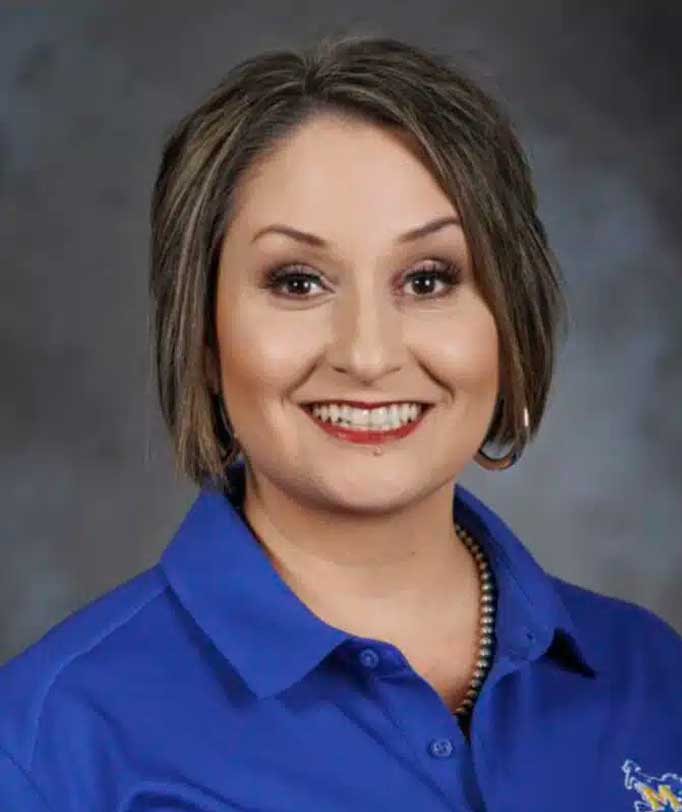
I am a McNeese graduate with a bachelor's degree in Family and Consumer Science and a concentration in Child and Family Studies. As a student, I competed on the rodeo team and served on the SGA board. I earned my master’s degree in 2022 from the University of South Dakota in Educational Administration and Leadership with a concentration in Adult and Higher Ed. I have over 13 years of experience in adult education and 20 years of educational experience.
My favorite part of being a Freshman Advisor is helping students navigate their new life routine as a college freshman by offering support with in-person office visits or by email to help students meet their goals. I always remind students of my favorite BB King quote – “Education is one thing no one can ever take away from you.” I believe that supporting students is vital to a student's success.
In my spare time, I raise registered American Brahman cattle, and I enjoy all the "country girl" things like hunting, fishing, growing a garden and cooking.